
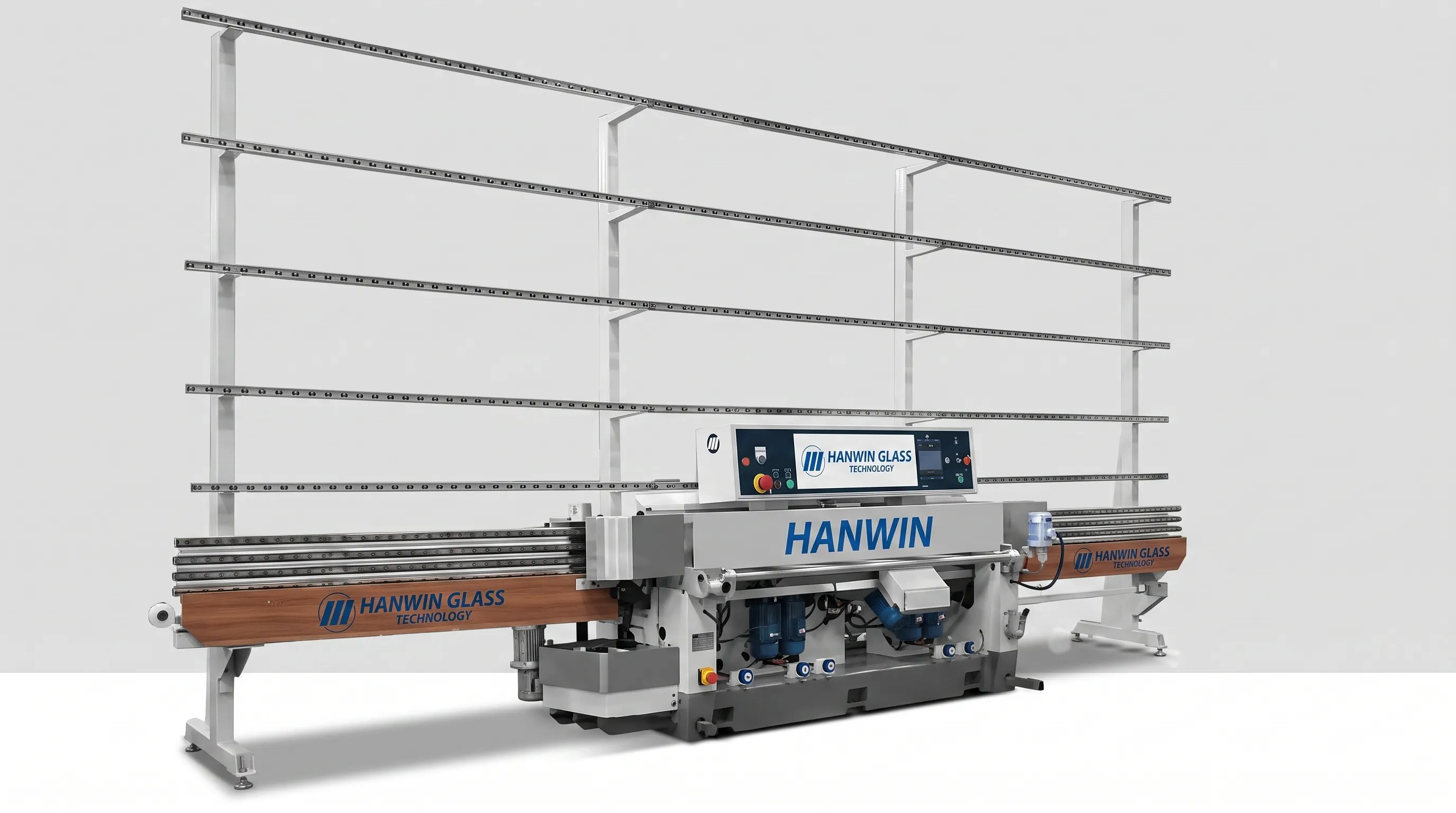
Vertical Straight-Line
Edging Machine
The vertical-orientation glass edging machine engineered for space-efficient, high-precision flat edge grinding and polishing — glass travels upright through 6 to 12 configurable spindles delivering rough grind, fine grind, and polish in a single pass.
The Machine, Up Close
From the GLASS EDGING SERIES — the single vertical straight-line edging machine delivers compact, high-precision edge processing on every panel.

How It Works
Five stages from raw edge to polished finish — glass travels upright through the vertical grinding zone.
Why This Vertical Edger
Six features that deliver maximum precision in minimum floor space.
Vertical Space-Saving Design
Glass travels upright through the machine — reducing the floor footprint by up to 40% compared to horizontal edgers of equivalent capacity. As compact as 5.8m long, it fits into workshops and production lines where floor space is at a premium.
6–12 Configurable Spindles
From 6 spindles for basic flat edging to 12 spindles with full polish capability — choose the exact configuration your production requires. Flat edging, front seaming, rear seaming, and polishing in a single pass.
Chain or Bearing Conveyor
Lower spindle models use durable chain conveyor for reliable everyday operation. Higher models upgrade to precision roller bearings for smoother glass travel, reduced friction, and higher processing speeds on thick glass.
Low-E Coating Removal Ready
Optional Low-E coating removal module grinds the coating from glass edges before tempering or laminating — essential for insulated glass units where edge seal adhesion depends on clean, coating-free glass surfaces.
I-Shape & L-Shape Layout
Flexible production line layout — install inline (I-shape) for straight-through flow, or at a corner (L-shape) to save floor space and connect with upstream/downstream equipment at right angles.
Auto Thickness Detection (PLC)
Professional and Enterprise models feature PLC-controlled automatic thickness adjustment. Input glass thickness on the touchscreen HMI and the machine repositions the front conveyor and spindle spacing automatically — changeover in seconds.
Up to 40% Smaller Footprint
Vertical orientation means glass travels upright — dramatically reducing floor space while delivering the same edge quality as horizontal edgers twice the size.
Technical Specs
Every parameter engineered for space-efficient, precision edge grinding.
How It Compares
Vertical edger vs. horizontal double edger vs. manual single-side edger.
Hanwin Vertical Edger leads in Footprint (95), Versatility (85), and Edge Quality (90) — the most space-efficient solution for precision edge grinding.
Where It Excels
From insulating glass lines to mirror workshops — one machine, every straight-edge need.
Insulating Glass Production
Edge Seal Preparation
Insulating glass units (IGUs) require precisely edging and clean glass edges for spacer bar adhesion and seal integrity. The vertical edger delivers consistent flat edge quality on 3–19mm glass at production speed — the standard for insulating glass lines worldwide.
Choose Your Configuration
Three tiers from 6 spindles to full smart-factory integration.
Standard
6 Spindles, ChainProfessional
9 Spindles, PLC + BearingEnterprise
12 Spindles, Smart FactoryKeep It Grinding
Five essential maintenance practices to maximize spindle life and edge quality.
Inspect all flat edging and seaming wheels for wear, chips, or glazing. Run a test piece and check edge quality — replace wheels when surface finish degrades or edge geometry drifts. Clean coolant nozzles at each wheel station.
Check coolant concentration and pH level (target 7.0–8.5). Drain and clean the water tank. Flush coolant lines with clean water to remove glass particle buildup. Top up coolant reservoir with filtered water.
Inspect chain or bearing conveyor for wear, tension, and alignment. Check all drive motor mounts and couplings for looseness. Lubricate chain links (chain models) or bearing races (bearing models) with approved lubricant.
Verify spindle alignment using a precision straightedge and dial indicator. Check for bearing play by grasping each spindle and checking for lateral movement. Realign or replace bearings if lateral play exceeds 0.02mm.
Perform complete machine calibration using laser alignment tools. Verify edge flatness, arris width, conveyor speed, and sensor alignment. Update PLC software if applicable. Conduct full safety system test including emergency stops and interlocked guards.
Common Questions
Everything you need to know about the Vertical Straight-Line Edging Machine.
A vertical edging machine processes glass with the sheet standing upright (on edge) rather than lying flat. The glass travels vertically through the grinding spindles, which significantly reduces the machine's floor footprint compared to horizontal edgers — making it ideal for workshops and production lines where space is limited.
The machine processes glass from 3mm to 30mm thickness as standard, with an optional 40mm capacity on higher models. The Professional and Enterprise configurations feature PLC-controlled automatic thickness adjustment — input the glass thickness on the touchscreen and the machine repositions automatically.
Vertical edgers use up to 40% less floor space than horizontal edgers of equivalent capacity. Glass travels upright through the grinding zone, which also makes it easier for operators to monitor edge quality in real-time. Horizontal edgers typically offer higher speeds but require significantly more floor space.
With 6 spindles, you get flat edge + arris (seam) quality. With 9–12 spindles, full polish edge quality is achievable. The final finish depends on the number of polishing spindles, wheel grit sequence, and processing speed. The Enterprise configuration with 12 spindles delivers the highest edge quality.
Yes. The machine supports both I-shape (inline) and L-shape (corner) layouts. The L-shape configuration is especially useful when connecting with upstream washing or downstream tempering equipment at right angles, saving additional floor space in the production line.
Yes. The Enterprise configuration includes an optional Low-E coating removal module that grinds the metallic coating from glass edges. This is essential for insulating glass production where edge seal adhesion depends on clean, coating-free glass surfaces.
Get a Quote
Tell us about your edge grinding needs and we'll recommend the right vertical edger configuration.
Contact Information
Pre-configured for Vertical Edging
Your enquiry is pre-tagged for our Vertical Straight-Line Edging Machine. Include your glass types, thickness range, daily volume, and preferred layout (I-shape/L-shape) for a faster response.
Smaller Footprint. Bigger Precision.
6 to 12 spindles grinding edges vertically at up to 6m/min — the most space-efficient precision edging solution for insulating, laminated, and decorative glass.