Washing Series
High-Efficiency Cleaning & Drying Solutions for Premium Glass Processing
HANWIN GLASS TECHNOLOGY · BEIJING, CHINA
About HANWIN Glass Technology
HANWIN GLASS is a group company specialized in the full range of glass pre-processing machinery, bringing more than 20 years of experience to customers worldwide. Founded in 2015 and built on a Development Strategy spanning two manufacturing bases in China (Beijing, Guangdong & Jiangsu), HANWIN focuses on the integrated, intelligent application of glass processing technology and equipment.
With core competitiveness built on innovative technology and attentive service, HANWIN's product technology has earned multiple National Invention Patents and Utility Model Patents, alongside ISO Quality System Certification, National Intellectual Property Standardization Certification, and National High-Tech Enterprise status. Every machine comes with a quality guarantee and 24-hour after-sales response, for life.

Pre-Sales Service
Sales Service
After-Sales Service
Introduction to Glass Washing Technology
What is Glass Washing?
Glass washing is the process of removing dust, oil, glass particles, and processing residue from a glass surface before it moves into the next production stage. Every upstream process — cutting, edging, or drilling — leaves microscopic debris and handling residue on the glass that must be fully removed before the panel continues down the line.
Why it matters
A clean surface is not just cosmetic — it is a functional requirement. Any residual particle or oil film can interfere with the adhesion of lamination interlayers, sealants in insulating glass units, or coating bonds. Residue left before tempering becomes a permanent defect baked into the glass under heat.
Modern factories rely on automated washing systems with self-adjusting brushes, precision air-knife drying, and closed-loop water management to meet these requirements at line speed — eliminating manual wiping, reducing water consumption, and delivering streak-free, spot-free glass every pass.
Better Glass Quality
A residue-free surface is the foundation for every downstream process and the finished product's appearance.
Improved Bonding Performance
Clean surfaces let laminating interlayers and sealants adhere fully and evenly.
Reduced Defects
Removing particles before tempering or coating prevents baked-in marks and inclusions.
Better Optical Appearance
Streak-free, spot-free glass meets the visual standard architectural buyers expect.
Higher Production Efficiency
Automated washing at line speed eliminates the bottleneck of manual cleaning and inspection.
Why Glass Washing Matters
A clean surface is not just cosmetic — it is a functional requirement. Any residual particle or oil film can interfere with the adhesion of lamination interlayers, sealants in insulating glass units, or coating bonds. Residue left before tempering becomes a permanent defect baked into the glass under heat.
Better Glass Quality
A residue-free surface is the foundation for every downstream process and the finished product's appearance.
Improved Bonding Performance
Clean surfaces let laminating interlayers and sealants adhere fully and evenly.
Reduced Defects
Removing particles before tempering or coating prevents baked-in marks and inclusions.
Better Optical Appearance
Streak-free, spot-free glass meets the visual standard architectural buyers expect.
Higher Production Efficiency
Automated washing at line speed eliminates the bottleneck of manual cleaning and inspection.
Glass Washing Process Flow
Glass Loading
Panel fed onto the washer's roller conveyor
Pre-Washing
Initial rinse loosens dust and loose debris
Brush Cleaning
Rotating brushes scrub both glass surfaces
Water Rinsing
Clean water removes brush residue and film
Air Knife Drying
High-pressure air knives dry the surface
Quality Inspection
Panel checked under light for spots/streaks
Next Stage
Sent to tempering, laminating or coating
One continuous, inspection-gated flow
Why every stage matters
Pre-washing loosens debris so the brushes can focus on film and residue rather than coarse particles that could scratch the glass. The main wash with heated water and detergent dissolves oils and stubborn contaminants, while the rinse zone removes all soap and suspended particles — leaving a chemically clean surface ready for drying.
Air-knife drying uses filtered, pressurized air to blast both faces completely dry in a single pass, eliminating water spots and streaks. Quality inspection under bright light catches any remaining defects before the panel moves to tempering or lamination — where a missed defect becomes permanent and far more costly to address.
Washing Series, Product Overview
Two washing platforms cover the full scope of glass cleaning and drying — horizontal washers for high-volume production lines and vertical washers for space-constrained workshops and vertical tempering feed.
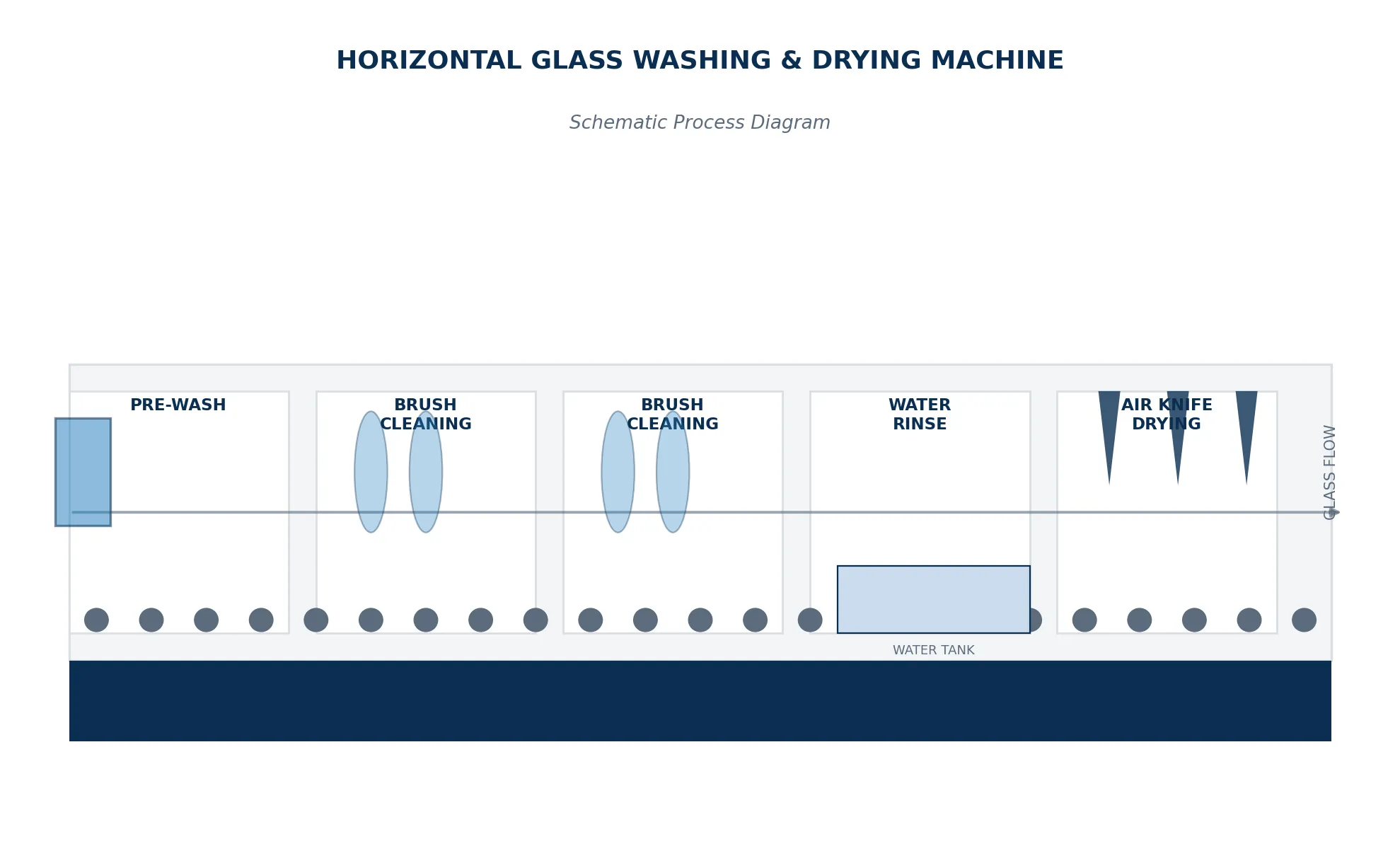
Horizontal Glass Washing & Drying Machine
The horizontal glass washing & drying machine is the production-line workhorse for high-volume glass cleaning — processing coated, Low-E, and uncoated glass at speeds up to 10m/min with self-adjusting brush sets and precision air-knife drying. Glass feeds flat through pre-wash, main wash, and rinse zones, then through dual air-knife drying stations that leave the surface completely dry and spot-free.
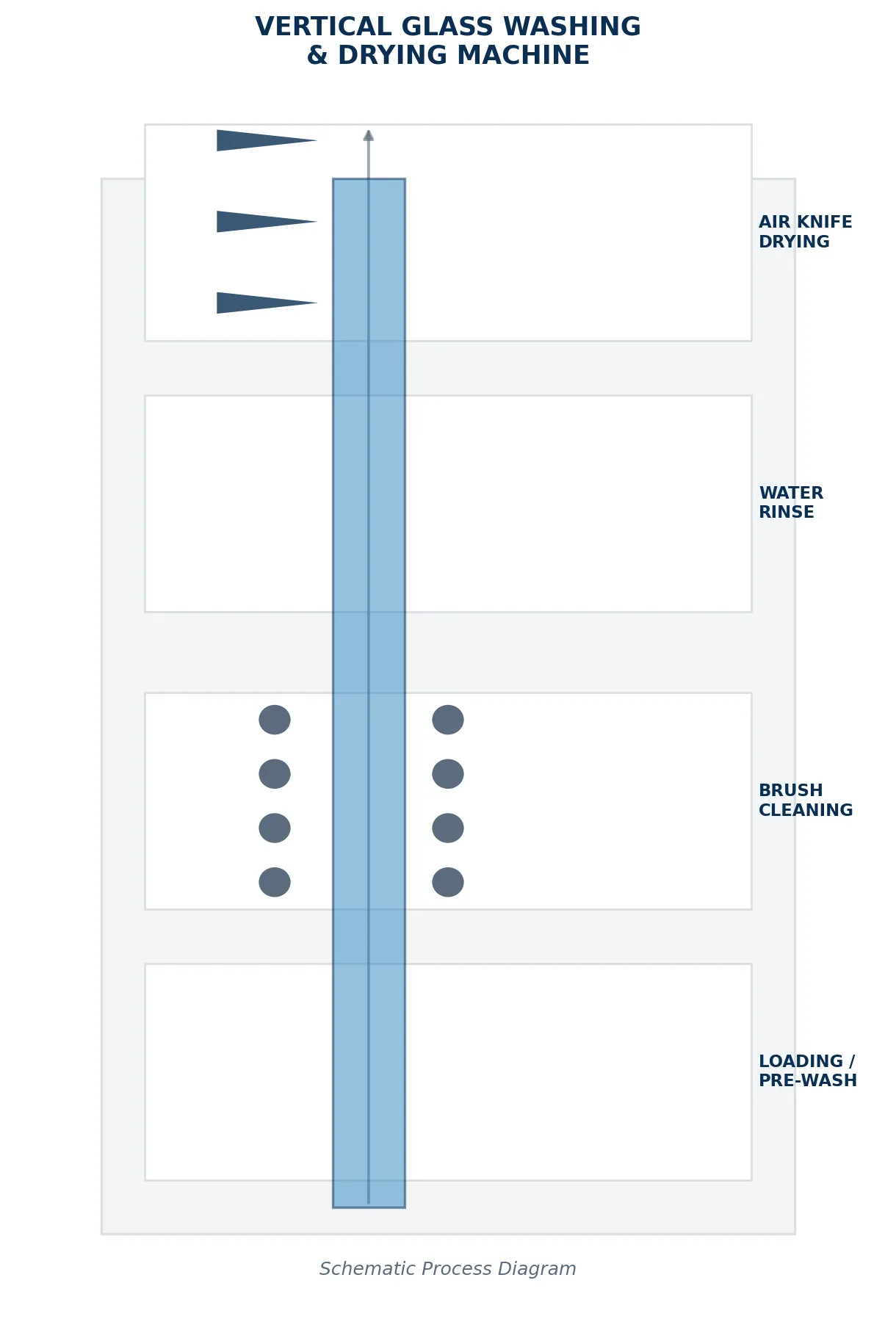
Vertical Glass Washing & Drying Machine
The vertical glass washing & drying machine is the space-saving, high-efficiency glass cleaning solution for workshops and production lines where floor space is at a premium — processing coated, Low-E, and uncoated glass vertically in a footprint 40% smaller than horizontal equivalents.
Horizontal vs. Vertical Glass Washing Machine
Choose the orientation that matches your factory layout — horizontal for high-volume lines, vertical for space-constrained workshops and vertical tempering feed.
| Factor | Horizontal Glass Washing Machine | Vertical Glass Washing Machine |
|---|---|---|
| Orientation | Glass flat on roller conveyor | Glass upright, vertical orientation |
| Max Width | 2500–3000mm | 2000 / 2500mm |
| Glass Thickness | 3–19mm | 3–19mm |
| Conveyor Speed | 1–10m/min (variable) | 2–12m/min (variable) |
| Washing Zones | Pre-wash + Main + Rinse | Pre-wash + Main + Rinse |
| Brush Sets | 2–3 self-adjusting | 2–3 Low-E self-adjusting |
| Drying System | Dual air knives | Dual air knives |
| Footprint | Full horizontal layout | 40% smaller than horizontal |
| Installed Power | 12–22kW | 8–16kW |
| Best For | High-volume production lines | Space-constrained workshops |
Where HANWIN Washing Machines Are Used
HANWIN's washing and drying machines deliver consistent, residue-free glass across the industries that depend on clean, defect-free surfaces.
Clean glass is the foundation of every quality process
Global Glass Washing Technologies & Extended Solutions
The following survey of washing and drying technologies widely used across the global glass processing industry helps buyers compare the options available for every production scenario.
IGU Line Washer
Vertical or horizontal washer for IG assembly lines
Working PrincipleA vertical or horizontal washer positioned directly ahead of the IGU assembly line, often mechanically linked to an edging machine so glass moves straight from edging into washing without a manual transfer.
Max width: up to ~3,300mm | Thickness: 3–19mm | Control: PLC + HMI
Insulating glass production lines, IGU assembly stations.
Complete Glass Processing Integration
One continuous conveyor path
Washing sits at a pivotal point in the line
Washing sits at a pivotal point in the line — the last cleaning opportunity before glass reaches tempering or lamination, where any missed defect becomes permanent. HANWIN's washing machines are engineered to match the conveyor height, control interface, and glass-handling logic of its Cutting, Edging, Drilling and Tempering Series, so panels move through a single continuous line rather than being manually lifted between stand-alone machines.
For factories running mixed production — some panels requiring washing, others already clean — the washing station can be configured as a bypass point on the line, so pre-cleaned panels pass straight through without a separate handling step.
Why Choose HANWIN
Six reasons partners trust us for their glass washing & drying line.
20+ Years of Experience
Two decades of dedicated expertise in glass processing machinery.
Professional Manufacturing
A leading brand for high-automation glass processing machinery in China.
Quality Control
ISO Quality System and National High-Tech Enterprise certified.
Customized Solutions
Machine configurations tailored to each factory's layout and glass mix.
Installation Support
Installation and commissioning support for customers worldwide.
Lifetime After-Sales Support
24-hour response with a lifetime quality guarantee on every machine.
Washing Series - Common Questions
About horizontal versus vertical washers, Low-E safety, IGU and jumbo machines.
Horizontal washers handle widths from 2500-3000mm and suit standard lines, while vertical washers (2500/2000mm widths) process glass on-edge and are ideal where floor space is limited. Both process 3-19mm glass at 1-10m/min.
Yes. Vertical washers offer dedicated Low-E brush sets, and the range is engineered for coated and off-line glass with self-adjusting brushes that avoid damaging coatings.
The IGU line washer is a direct on-line washer built for insulating glass unit lines, handling glass up to about 3,300mm with automatic thickness adjustment from 3-19mm.
Yes. The jumbo size washing machine is a reinforced wide-body unit handling glass up to about 4,000mm with 3-4 brush sets for large architectural sheets.
Yes. The automatic cleaning and drying production line is fully automated with PLC control and is ERP/MES ready, so it can run as a synchronized station in a smart factory line.
Self-adjusting brushes and high-efficiency air knives keep the machine performing and reduce downtime, with easy-access brush and filter assemblies for routine service.
Complete Glass Processing Solutions
Beyond washing — HANWIN's full product ecosystem for every stage of glass processing
Hanwin Glass Technology