
Glass Drilling Series
Precision Drilling Solutions for Modern Glass Processing
HANWIN GLASS TECHNOLOGY · Beijing, FOSHAN, CHINA

About HANWIN Glass Technology
HANWIN GLASS is a group company specialized in the full range of glass pre-processing machinery, bringing more than 20 years of experience to customers worldwide. Founded in 2015 and built on a Development Strategy spanning two manufacturing bases in China (Beijing, Guangdong & Jiangsu), HANWIN focuses on the integrated, intelligent application of glass processing technology and equipment.
With core competitiveness built on innovative technology and attentive service, HANWIN's product technology has earned multiple National Invention Patents and Utility Model Patents, alongside ISO Quality System Certification, National Intellectual Property Standardization Certification, and National High-Tech Enterprise status. Every machine comes with a quality guarantee and 24-hour after-sales response, for life.

Pre-Sales Service
Sales Service
After-Sales Service
Introduction to Glass Drilling Technology
What is Glass Drilling?
Glass drilling is the process of creating precise, clean holes through a glass panel to accept hardware, fittings, or fixing door handles and locks, hinges, standoffs, curtain-wall brackets, and appliance mounting points. Because a drilled hole removes material from the glass, it becomes the single highest-stress point on the panel.
Why precision matters
Hole diameter, position, and edge distance must be held to tight tolerance — industry practice keeps edge distance at roughly twice the hole diameter, with drilling performed from both faces to prevent exit-side chipping. Any deviation becomes a crack-initiation point once the glass is tempered or put under load.
Modern factories rely on CNC-guided and laser drilling systems to meet these requirements at production speed — automation removes manual marking error, holds accuracy consistently across large batches, and keeps breakage rates low even on large architectural panels.
Structural Safety
Correct hole size and edge distance prevent stress cracks before and after tempering.
Hardware Compatibility
Precise diameters and positions ensure hinges, locks and fittings seat correctly.
Production Speed
CNC and multi-spindle systems drill batches in a fraction of manual processing time.
Repeatable Accuracy
Automated positioning holds tolerance consistently from the first panel to the last.
Glass Drilling Production Flow
Glass Loading
Cut and edged sheets fed onto the drilling table
Positioning
Sheet aligned to programmed hole coordinates
Drilling
Spindles drill from one or both faces to size
Inspection
Hole diameter, position and finish checked
Washing
Panel cleaned of glass particles and coolant
Further Processing
Sent to tempering, laminating or assembly
One continuous, inspection-gated flow
Why this sequence matters
Inspection between drilling and washing catches out-of-tolerance holes before the panel moves further down the line — far cheaper than discovering a defect after tempering. Washing then removes all glass dust and coolant residue, which would otherwise interfere with lamination, coating, or sealant adhesion in later stages.
Integrating drilling directly into a cutting-edging-drilling-washing line, rather than running it as an isolated station, keeps handling to a minimum and reduces the breakage risk that comes with repeatedly moving large glass panels.
Drilling Methods & Hole Types
Drilling Methods
Diamond-Core Drilling
Diamond-tipped hollow core bits — the industry-standard method. Typical accuracy ±0.10–0.15mm.
CNC-Guided Drilling
Computer-controlled spindle positioning drills multi-hole patterns automatically. Tightens accuracy to about ±0.05mm.
Laser Drilling
Non-contact focused laser (e.g. MOPA fiber) for thin, coated or solar glass, with edge chipping as fine as 0.25–0.4 microns.
Typical Process Parameters
Glass drilling generally runs spindle speeds of roughly 3,000–8,000 RPM with continuous water-coolant flow to control heat and flush debris. Thin substrates (under 2mm) call for higher speed and lighter feed pressure; glass over 6mm needs slower speed and more coolant to manage heat buildup.
Common Hole Types
Standard Round Hole
The most common type, for handles, hinges and standoffs.
Countersunk Hole
Angled recess lets screw heads sit flush with the glass surface.
Elongated / Slotted Hole
Allows adjustment tolerance in bracket and fixing alignment.
Large-Diameter Hole
For appliance ports, handrail posts and cable pass-throughs.
Glass Drilling Applications
Precision-drilled glass is required across nearly every branch of architectural, furniture, and consumer glass manufacturing.
Precision hole drilling for every glass industry
HANWIN Glass Drilling Series, Product Range
Five precision machines cover the full glass hole processing flow — from CNC vertical drilling and laser drilling to fully automatic drilling and big-hole processing.
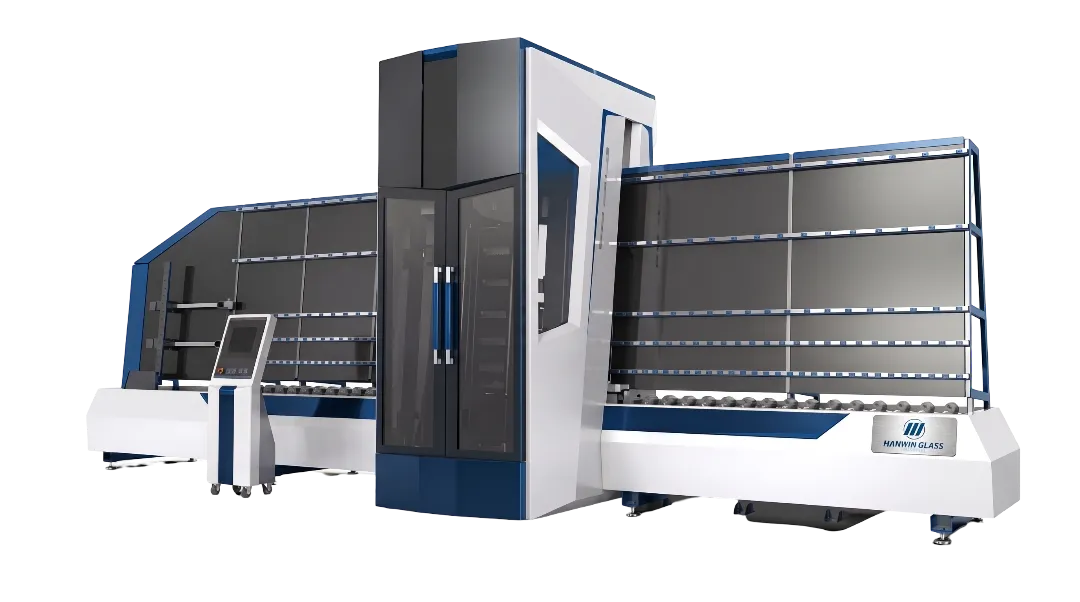
CNC Vertical Glass Drilling Machine
Vertical-orientation CNC drilling for architectural and furniture glass panels — 5-axis simultaneous control with dual electric spindles, automatic tool changer and Mitsubishi CNC system. Space-saving footprint, line-integratable.
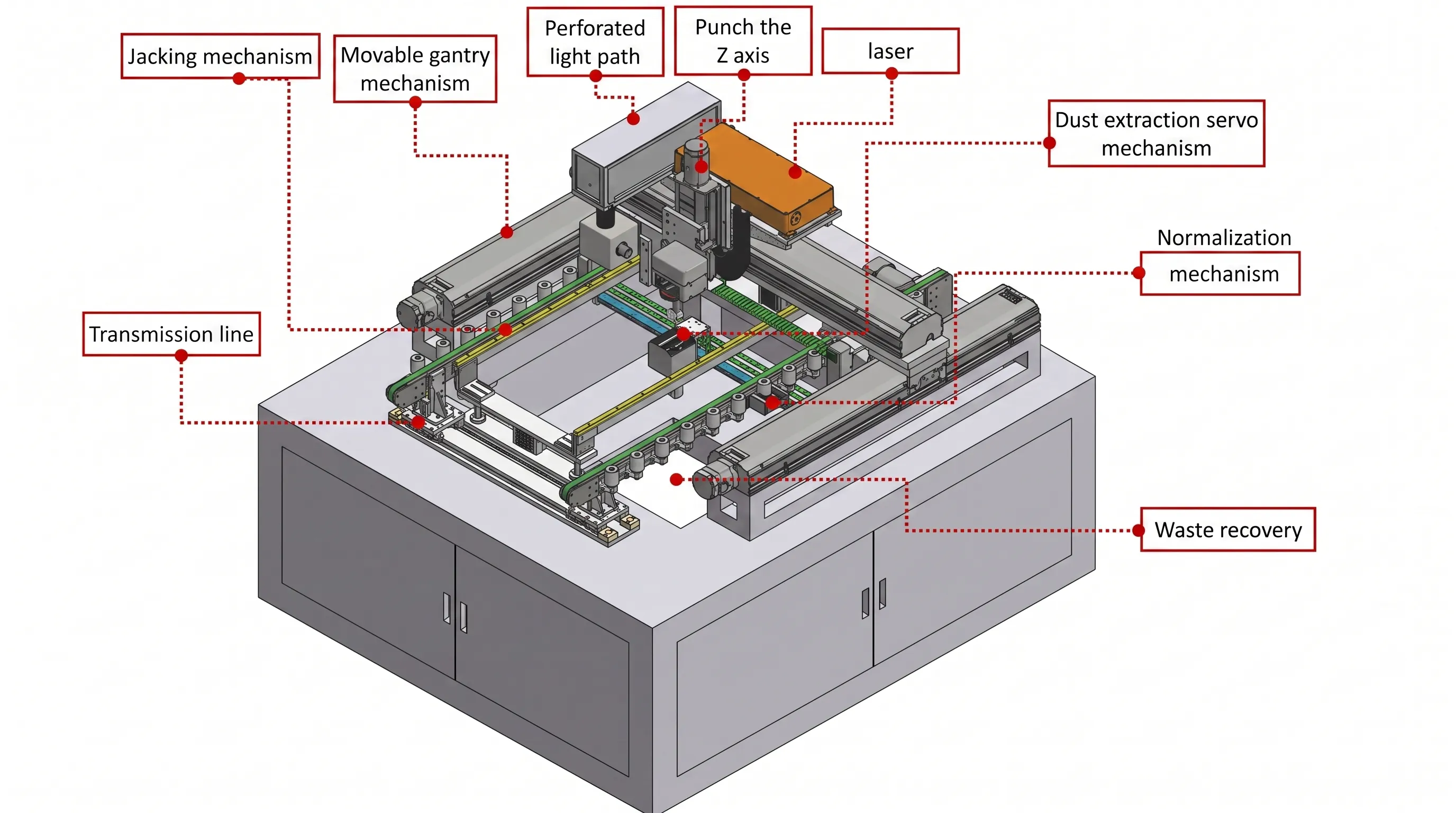
CNC Laser Drilling Machine
Non-contact laser drilling for thin, coated and solar glass — green laser (532nm) with up to 3 laser heads and CCD camera positioning, delivering minimal micro-cracking and ultra-fine hole edges.
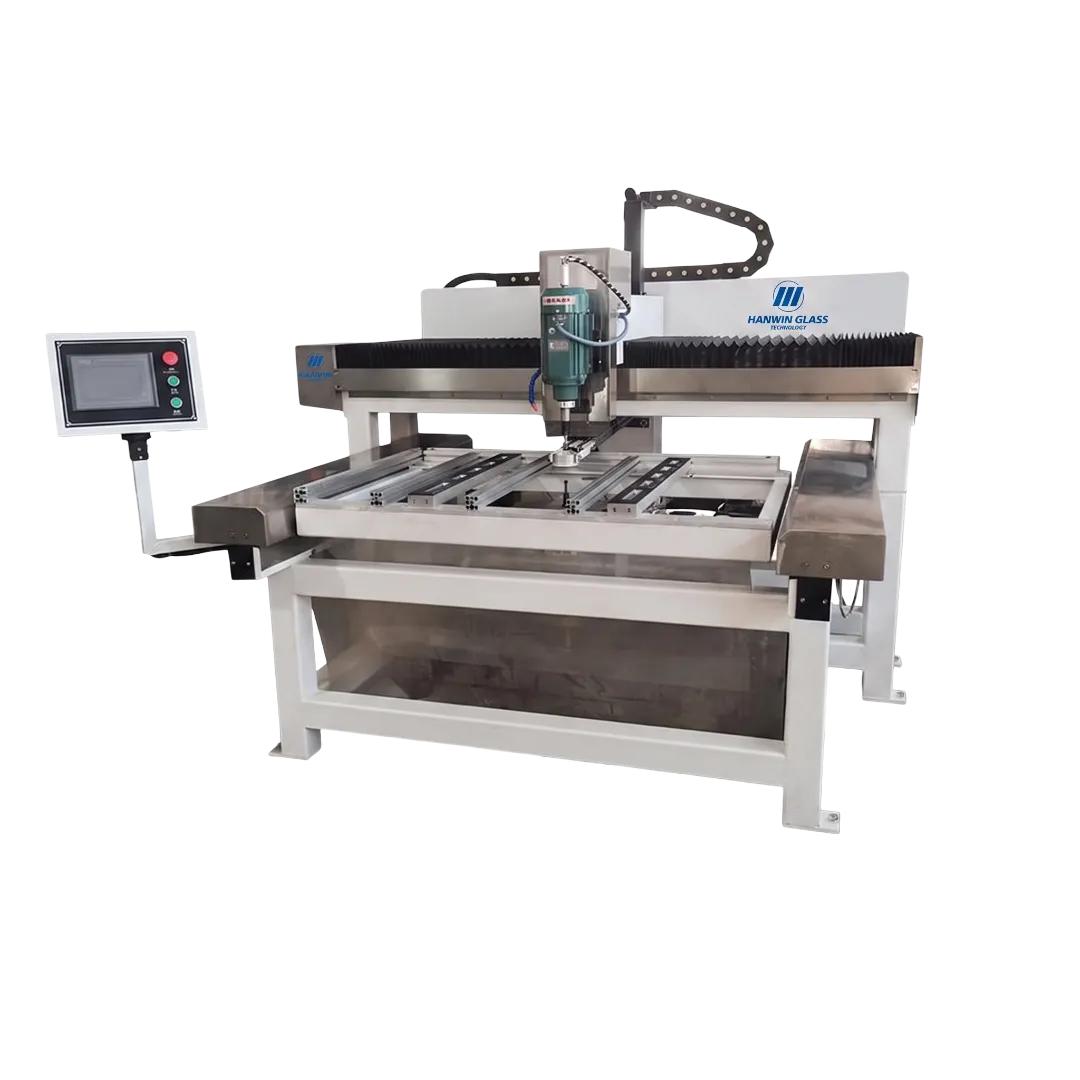
CNC Glass Drilling Machine
Automatic CNC-controlled drilling for standard production runs and batch hole programs — dual drilling heads, servo-driven positioning and PLC + touch screen control for high-volume factory production lines.
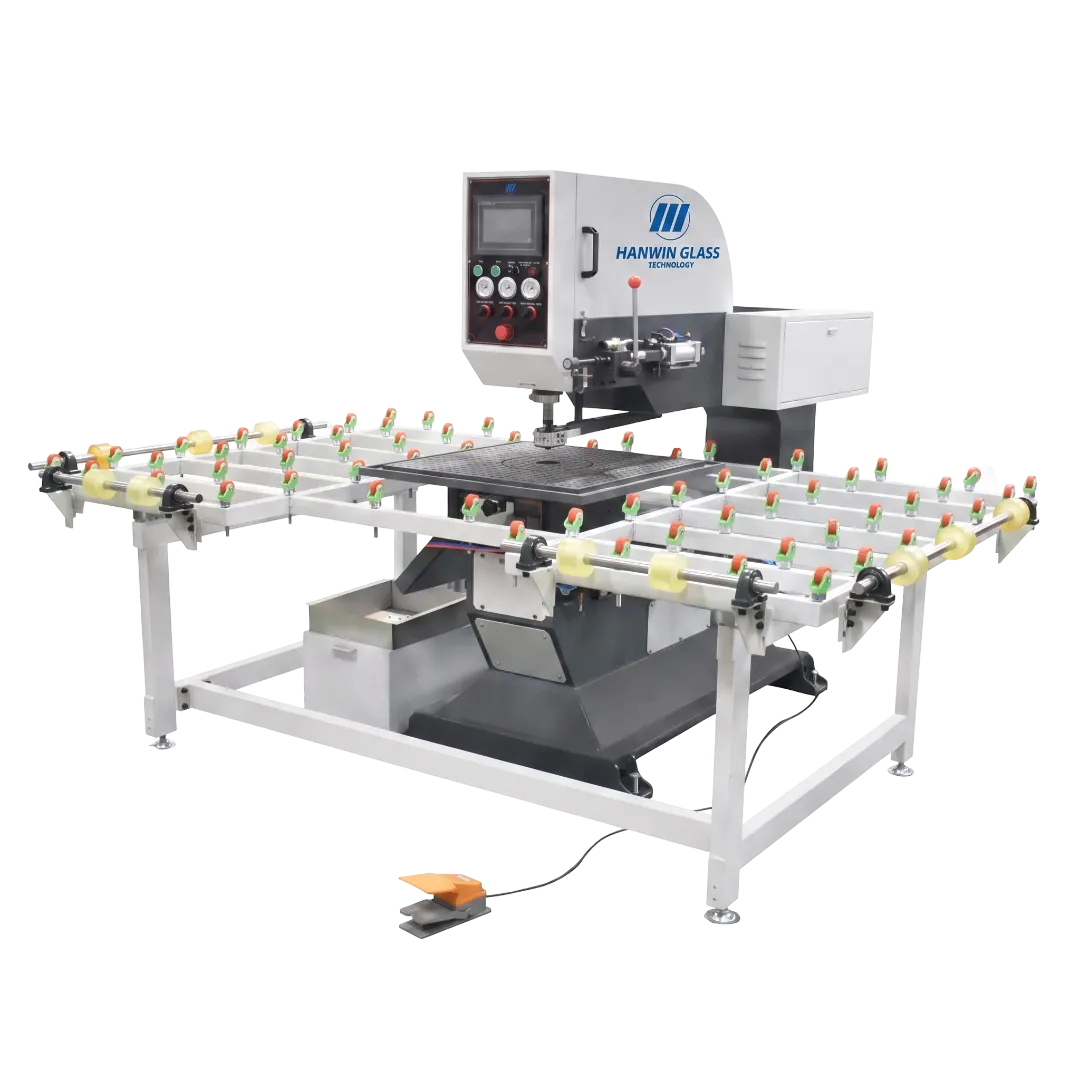
Automatic Glass Drilling Machine
Streamlined automatic drilling built for high-volume factory production lines — conveyor belt automatic feeding, dual drilling heads with AC servo X/Z/W 3-axis positioning, and PLC + touch screen control.
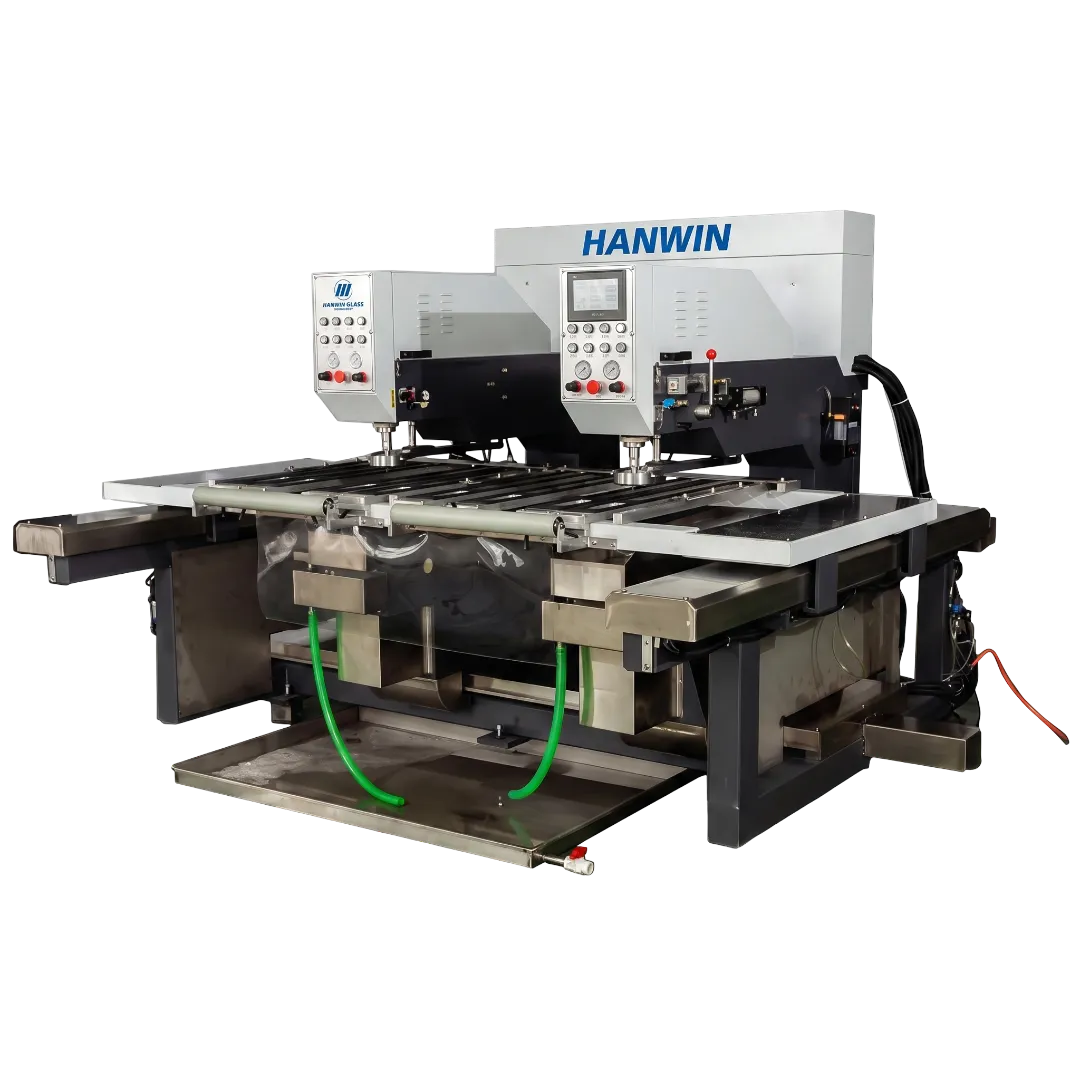
Double Heads Big Hole Drilling Machine
Simultaneous dual-hole processing for large-diameter appliance and handrail glass holes — two pairs of upper and lower spindles drill Φ50–Φ230mm holes through 6–15mm glass at ±0.30mm accuracy.
HANWIN builds its drilling series on the same CNC control, servo positioning, and water-cooled spindle technology used across its Cutting and Edging Series. For detailed model-specific technical drawings and configuration options, please request the latest HANWIN Drilling Series datasheet.
CNC vs. Traditional Drilling
Moving from manual drilling to CNC automation removes operator dependence, shrinks cycle times, and delivers identical hole quality on every panel.
| Factor | Traditional / Manual Drilling | CNC / HANWIN Automated Drilling |
|---|---|---|
| Accuracy | ±0.10–0.15mm, operator-dependent | Down to ±0.05mm, program-controlled |
| Efficiency | Single hole at a time, slow setup | Multi-hole programs, continuous cycle |
| Labor | Skilled operator required per machine | One operator can oversee multiple lines |
| Repeatability | Varies between operators and shifts | Identical results across every panel |
| Maintenance | Frequent bit changes and manual checks | Automated monitoring, scheduled service |
| Quality | Inconsistent edge chipping risk | Clean, consistent holes with dual-face drilling |
Global Glass Drilling Technologies & Extended Solutions
The following pages survey drilling technologies widely used across the global glass processing industry — an industry reference for buyers comparing options for every production scenario.
Multi-Spindle Glass Drilling Machine
Industry-standard multi-hole drilling center
Working PrincipleTwo to five independent spindle units, each with its own feed and adjustable pitch, drill multiple holes on a single panel simultaneously rather than one hole at a time.
Spindles: 2–5 units | Hole Ø: 4–50mm | Speed: 3,000–8,000 RPM
Curtain wall brackets, multi-fixing furniture panels, batch production runs.
Horizontal Glass Drilling Machine
Industry-standard horizontal-bed drilling machine
Working PrincipleGlass is clamped flat on a horizontal worktable with pneumatic clamping; upper and lower drill bits work from both faces to prevent exit-side chipping.
Hole Ø: 4–50mm | Thickness: 3–19mm | Drive: pneumatic clamping, dual-bit feed
Shower door glass, furniture glass, general fabrication shops.
Production Line Integration
One continuous conveyor path
Integrating drilling into a full processing line
HANWIN drilling machines are designed to sit between the edging and washing stations of a complete line, matching the conveyor height, control interface, and glass-handling logic of HANWIN's Cutting and Edging Series. This keeps panels moving on a single continuous conveyor path rather than being manually lifted between stand-alone machines.
For factories running mixed production — some panels requiring holes, others not — the drilling station can be configured as a bypass point on the line, so undrilled panels pass straight through to washing without a separate handling step.
Why Choose Hanwin Glass Technology
Six reasons partners trust us for their glass drilling line.
20+ Years of Experience
Two decades of dedicated expertise in glass processing machinery.
Global Customers
Equipment installed and supported across international markets.
Advanced Technology
CNC control, servo drives, and multiple National Invention Patents.
Certified Quality Assurance
ISO Quality System and National High-Tech Enterprise certified.
Global Installation Services
Installation and commissioning support for customers worldwide.
Lifetime After-Sales Support
24-hour response with a lifetime quality guarantee on every machine.
Drilling Series - Common Questions
About hole sizes, thickness coverage, laser drilling and ERP integration.
The range covers Ø4-50mm on the CNC vertical machine, Ø4-60mm on the CNC drilling machine, Ø2-40mm on the laser machine and Ø50-230mm big holes on the double-heads machine, with automatic drilling up to Ø130mm on sheets up to 2700mm wide.
CNC and automatic machines drill glass from 3-25mm (up to 30mm on the automatic machine), while the nanosecond laser drilling machine is designed for ultra-thin glass from 0.8-4mm.
The CNC laser drilling machine uses nanosecond laser heads to drill without mechanical contact, producing chip-free holes in ultra-thin and coated glass that conventional drilling can damage.
CNC drilling machines hold ±0.05mm accuracy with batch programming for repeatability, and the vertical machine supports 1-2 pairs of bits for simultaneous drilling.
Yes. The series is designed with ERP bar-code integration, so hole patterns load automatically from production data for synchronized, paperless operation.
The double-heads big hole drilling machine drills 2-4 holes simultaneously, and CNC machines can be equipped with 1-2 pairs of bits to shorten cycle times.
Complete Glass Processing Solutions
Beyond drilling — HANWIN's full product ecosystem for every stage of glass processing
Hanwin Glass Technology